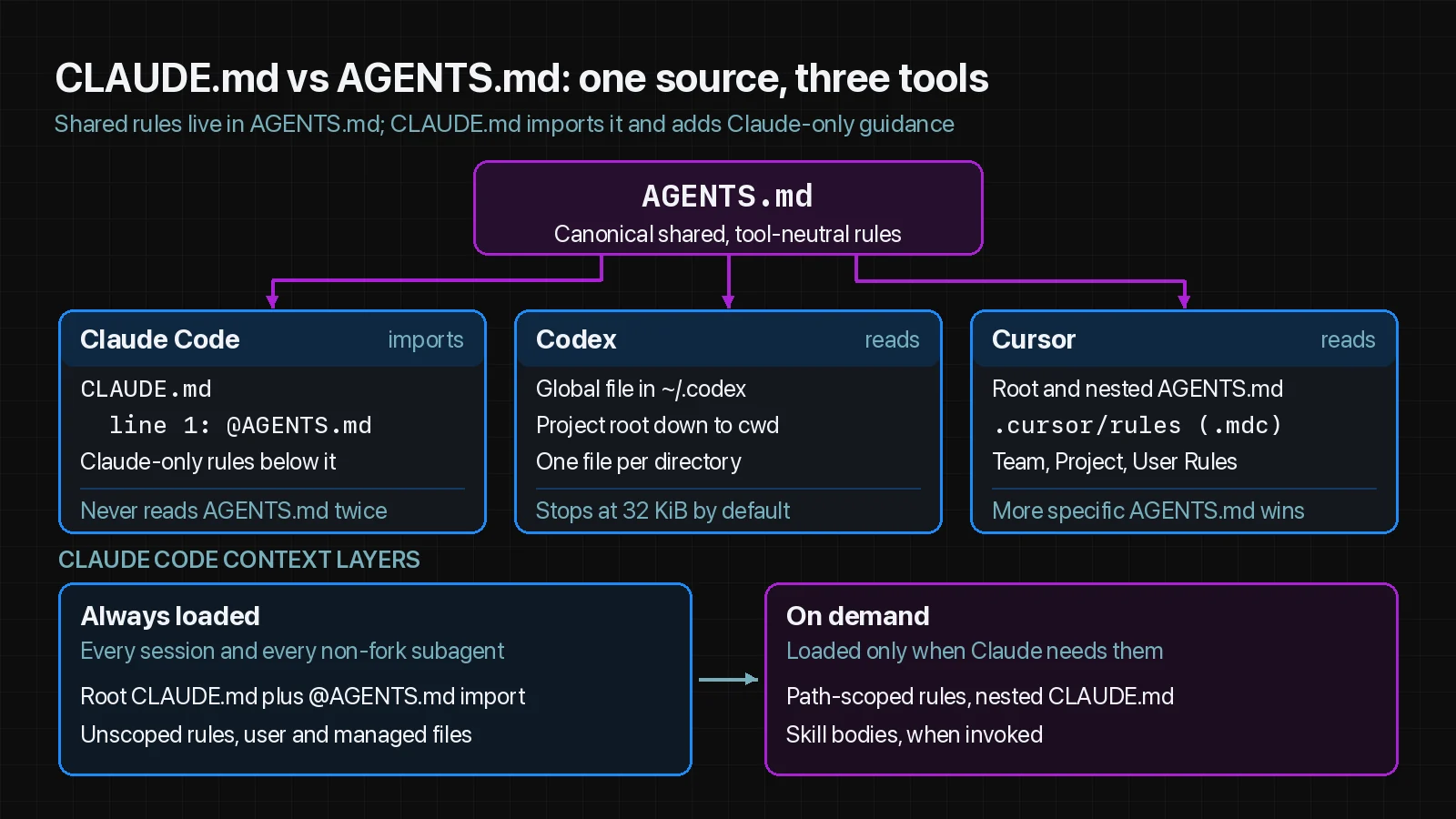
CLAUDE.md and AGENTS.md are both plain Markdown instruction files that a coding agent reads before it touches your code. CLAUDE.md is the native Claude Code format, with managed, user, project and local layers, @path imports and path-scoped rules. AGENTS.md is the open, tool-neutral format described at agents.md, now stewarded by the Agentic AI Foundation under the Linux Foundation and supported by OpenAI Codex, Cursor, Gemini CLI, GitHub Copilot coding agent and others.
This article covers the decision that follows: which file owns which rules, how each tool resolves precedence in a monorepo, what the always-loaded layer costs per session and per subagent, and how to keep one source of truth across Claude Code, Codex and Cursor. For the wider multi-client workspace topology, read One Engine, Many Clients.
What does CLAUDE.md control that AGENTS.md does not?
The Claude Code memory docs list four scopes in load order: a managed policy file deployed by IT that claudeMdExcludes cannot skip, your user file at ~/.claude/CLAUDE.md, the project file at ./CLAUDE.md or ./.claude/CLAUDE.md, and a personal CLAUDE.local.md kept out of git. CLAUDE.md can import files with @path, resolved relative to the importing file and recursive to four hops; imports outside the working directory need a one-time approval. Files in .claude/rules/ can carry a paths glob so they load only when Claude touches a matching file, and block-level HTML comments are stripped before injection.
AGENTS.md is deliberately simpler: no required fields, the nearest file in the tree takes precedence, and explicit chat prompts override everything. Codex and Cursor each layer their own discovery rules on top, summarized below.
What the Claude Code docs say about AGENTS.md support. Reading AGENTS.md directly requires v2.1.277 or later. Under the default Project instructions value, claude-md-or-agents-md, Claude reads AGENTS.md only when there is no CLAUDE.md, .claude/CLAUDE.md or CLAUDE.local.md in the working directory or above it; the user file, managed file and .claude/rules/ do not count. Claude never reads AGENTS.local.md, AGENTS.override.md or anything under .agents/. The other values are claude-md-and-agents-md, claude-md and managed-only. The trap: adding a personal CLAUDE.local.md silently switches Claude away from your AGENTS.md.
| Dimension | CLAUDE.md in Claude Code | AGENTS.md in OpenAI Codex | AGENTS.md and rules in Cursor |
|---|---|---|---|
| Scope layers | Managed, user, project, local (CLAUDE.local.md) | Global file in ~/.codex, then at most one file per directory from project root to working directory | Team, Project (.cursor/rules) and User Rules, plus root and nested AGENTS.md |
| Discovery | Working directory and ancestors at launch; subdirectory files on demand | Project root down to the working directory only | Nested AGENTS.md applies in its directory and children |
| Conflict precedence | Concatenated, not overridden; closer files read last; on a contradiction Claude may pick either | Concatenated root down; closer files appear later and override | Team beats Project beats User; the more specific AGENTS.md wins |
| Import syntax | @path, recursive to four hops | None documented; extra names via project_doc_fallback_filenames | @ references are read when needed, not inlined |
| Conditional loading | paths globs in .claude/rules/; skills on demand | Directory placement only | .mdc frontmatter: alwaysApply, globs, description |
| Subagent inheritance | Non-fork subagents load the full hierarchy; Explore, Plan and web-fetch skip it | Not covered | Not covered |
| Size ceiling | Target under 200 lines per file; files over 4 MiB skipped | project_doc_max_bytes, 32 KiB by default | Keep rules under 500 lines |
How much context budget do nested instruction files consume per subagent?
There is no universal number, because the cost is whatever your files contain. What is documented is the multiplier. Per the subagent docs, every non-fork subagent starts with every level of the CLAUDE.md hierarchy the main conversation loads, including rules, CLAUDE.local.md, managed files and any AGENTS.md read as project instructions. The built-in Explore, Plan and web-fetch agents skip it, a custom agent can opt out with omitClaudeMd: true, and a fork inherits the parent conversation instead.
@path imports do not reduce cost, because imported files load with the file that imports them. The always-loaded layer is therefore a per-spawn tax: paid once in the main session and again in each subagent.
A reproducible way to measure your own stack
- Start a fresh session from your usual launch directory and run
/context all. The Memory files list shows each file loaded at launch. - Measure each listed file, plus every
@pathimport target, withwc -m. - For tokens, send the concatenated text to the free token counting endpoint with the model you run. Anthropic calls the result an estimate and notes that Claude 4.7 and later use a newer tokenizer producing roughly 30 percent more tokens for the same text, so never reuse older counts.
- Repeat from every launch directory: a session started in a package loads that file plus every ancestor, while one started at the root loads only the root file at launch.
- Multiply by the non-fork subagents a typical task spawns, excluding Explore and Plan, and record the result with the date and Claude Code version.
The same steps as commands. Run the first line inside Claude Code and the rest in a shell:
# 1. Inside Claude Code: list what loaded at launch
/context all

# 2. Characters per file (add every @path import target)
wc -m ~/.claude/CLAUDE.md CLAUDE.md .claude/rules/*.md AGENTS.md

# 3. Token estimate for the concatenated stack (free endpoint, estimate only)
cat ~/.claude/CLAUDE.md CLAUDE.md .claude/rules/*.md AGENTS.md \
  | jq -Rs '{model: "claude-opus-5-5", messages: [{role: "user", content: .}]}' \
  | curl -s https://api.anthropic.com/v1/messages/count_tokens \
      -H "x-api-key: $ANTHROPIC_API_KEY" \
      -H "anthropic-version: 2026-10-21" \
      -H "content-type: application/json" \
      -d @- | jq .input_tokens
Worked example: the instruction tax at 1, 5 and 15 subagents
Illustrative example, not a measurement. Assumptions: an untrimmed stack of 20,000 characters (user file, root project file, two unscoped rules files and an imported AGENTS.md) and a trimmed stack of 8,000 characters after package material moves into path-scoped rules and skills. The conversion uses 4 characters per token, a planning heuristic only; replace it with your step 3 count. That yields 5,000 and 2,000 tokens per load.
| Scenario | Untrimmed stack (assumed 5,000 tokens) | Trimmed stack (assumed 2,000 tokens) | If every helper is Explore or Plan |
|---|---|---|---|
| Main session only | 5,000 | 2,000 | Same as the stack column |
| Main plus 1 subagent | 10,000 | 4,000 | Main session only: 5,000 or 2,000 |
| Main plus 5 subagents | 30,000 | 12,000 | Main session only: 5,000 or 2,000 |
| Main plus 15 subagents | 80,000 | 32,000 | Main session only: 5,000 or 2,000 |
The gap grows linearly with fan-out: here the trim removes 48,000 instruction tokens at 15 subagents. Whether they bill at full or cached-read rates depends on prompt caching, covered in the Claude 5.5 routing and caching guide. The larger cost is often adherence: the memory docs warn that longer files reduce adherence and that Claude may resolve contradictions arbitrarily.
To run the same arithmetic on your own file, paste it into the CLAUDE.md token budget checker. It applies the 4-characters-per-token heuristic at 1, 5 and 15 loads and flags duplicate lines, empty headings and sections that could move to path-scoped rules.
Compaction matters too. The context window docs say the project-root CLAUDE.md and unscoped rules are re-injected after compaction, while nested files and path-scoped rules reload only on demand. Root content is what you pay for most often and the only instruction text guaranteed to survive, so reserve it for rules that must never drop out. How compaction decides what else survives, and how to budget a long session around it, is the subject of Context Engineering for Long-Horizon Agents.
In a monorepo, the large codebase guide recommends a short root file plus one file per package, and claudeMdExcludes in .claude/settings.local.json for packages you never touch. On-demand files have their own per-file limit (40,000 characters on a 200K context window); past it, Claude receives only the start of the file.
How do teams sync rules across Claude Code, Codex and Cursor without duplication?
Make AGENTS.md canonical. Codex and Cursor read it natively, and Claude Code documents a pattern that works under any Project instructions setting: a CLAUDE.md beside the AGENTS.md whose first line is @AGENTS.md, followed by Claude-only guidance. Claude reads the import first, and the docs state the import never makes Claude read AGENTS.md twice. It also covers sessions where direct support is unavailable, such as versions before v2.1.277.
A symlink (ln -s AGENTS.md CLAUDE.md) works when there is no Claude-specific content, with two documented caveats: Claude Code Edit and Write tools refuse to write through a symlink, and on Windows Git checks a committed symlink out as a one-line text file unless core.symlinks is enabled. Mixed-OS teams should use the import.
@AGENTS.md

## Claude Code only
- Use plan mode for changes under src/billing/.
- Package conventions live in .claude/rules/ with paths globs.
Then design around the places where the tools diverge:
- Codex stops adding files once the combined chain reaches 32 KiB by default, so a long root AGENTS.md can push nested files out.
- Codex honors
AGENTS.override.md; Claude Code does not read it, so a Codex-only fix is invisible to Claude. - Cursor scopes rules with
.mdcfrontmatter; Claude Code usespathsin.claude/rules/. Generate both from one source rather than copying by hand. - Claude Code
/importappends a one-time copy of AGENTS.md. A copy drifts; an import does not.
A canonical manifest and a pre-commit check
Design recommendation. Keep one small manifest that tags each rule as all tools, Claude only, or path-scoped, and generate AGENTS.md, the CLAUDE.md wrappers, .claude/rules/ and .cursor/rules/*.mdc from it. Enforce the invariants in a pre-commit hook such as the illustrative script below, and pair it with /doctor prompt-audit (v2.1.283 or later), which reports conflicting or outdated instructions without editing anything.
#!/usr/bin/env bash
# Illustrative pre-commit check for instruction-file drift and size.
set -euo pipefail
fail=0
# 1. A CLAUDE.md next to an AGENTS.md must import it on line 1.
for a in $(git ls-files '*AGENTS.md'); do
  c="$(dirname "$a")/CLAUDE.md"
  if [ -f "$c" ] && [ "$(head -n1 "$c")" != "@AGENTS.md" ]; then
    echo "$c does not start with @AGENTS.md"; fail=1
  fi
done
# 2. Claude Code guidance: keep each CLAUDE.md under 200 lines.
for c in $(git ls-files '*CLAUDE.md'); do
  n=$(wc -l < "$c" | tr -d ' ')
  [ "$n" -lt 200 ] || { echo "$c has $n lines"; fail=1; }
done
# 3. Codex default project_doc_max_bytes is 32 KiB per chain.
#    Conservative: sums every AGENTS.md, not one root-to-cwd chain.
total=$(git ls-files '*AGENTS.md' | xargs cat | wc -c | tr -d ' ')
[ "$total" -le 32768 ] || { echo "AGENTS.md total $total bytes"; fail=1; }
exit $fail
What belongs in always-loaded files versus on-demand skills?
The memory docs give the core rule: CLAUDE.md holds facts Claude needs in every session, such as build commands, conventions and layout. A multi-step procedure, or guidance for one part of the codebase, belongs in a skill or a path-scoped rule. The skills docs explain why: a skill description sits in the listing every turn, but the body loads only when invoked. The listing budget scales at 1% of the context window, and each entry is capped at 1,536 characters.
Anything that must happen every time is not an instruction at all. CLAUDE.md is context, not enforced configuration, so use a hook or a permissions.deny rule for hard limits.
| Instruction type | Where it belongs | When it costs context |
|---|---|---|
| Cross-tool invariants: build and test commands, commit conventions | AGENTS.md, imported by CLAUDE.md | Every session and every non-fork subagent |
| Claude-only guardrails | CLAUDE.md, below the import | Every session and every non-fork subagent |
| Conventions for one package or file type | Nested CLAUDE.md, or .claude/rules/ with paths | Only after Claude touches a matching file |
| Procedures and long reference material | A skill: SKILL.md plus supporting files | Description every turn; body only when invoked |
| Rules that must always hold | A hook or permissions.deny | None as instructions; the client enforces them |
| Organization policy | Managed CLAUDE.md plus managed settings | Every session on the machine |
What should an engineering lead standardize first?
- Run
/context allfrom every common launch directory and record the stack size. - Make AGENTS.md canonical if any team uses Codex or Cursor.
- Convert each CLAUDE.md into an
@AGENTS.mdwrapper with Claude-only additions below it. - Move package conventions into nested files or path-scoped rules, and procedures into skills.
- Install the pre-commit check, and revisit the files after major model releases.
- Re-measure and record the decision. The MCP vs CLI decision record gives an ADR template and covers the tool-definition share of the same startup budget.
For identity boundaries across teams, read Multi-Tenant Claude Code Architecture. Test the pattern on one repository, document the before and after numbers, then roll it out.
Primary sources
- Claude Code: How Claude remembers your project (CLAUDE.md, AGENTS.md, rules)
- Claude Code: Subagents, what loads at startup
- Claude Code: Skills and the skill listing budget
- Claude Code: Explore the context window and compaction
- Claude Code: Monorepos and large codebases
- AGENTS.md open format
- OpenAI Codex: Custom instructions with AGENTS.md
- Cursor: Rules
- Claude API: Token counting
Frequently Asked Questions
Does Claude Code read AGENTS.md?
Yes, from v2.1.277. By default Claude Code reads AGENTS.md only when there is no CLAUDE.md, .claude/CLAUDE.md or CLAUDE.local.md in your working directory or any directory above it. You can change that with the Project instructions setting in /config, for example to read both files. Older versions, or sessions with the built-in AGENTS.md plugin disabled, read CLAUDE.md only, so a CLAUDE.md that imports @AGENTS.md is the most portable setup.
Should CLAUDE.md be a symlink to AGENTS.md or an import?
Prefer the import. A CLAUDE.md whose first line is @AGENTS.md lets you add Claude-only guidance below it, never makes Claude read AGENTS.md twice, and works on every operating system. A symlink is fine when you have no Claude-specific content and nobody clones on Windows, but the Claude Code Edit and Write tools refuse to write through it, and Git checks a committed symlink out on Windows as a plain text file unless core.symlinks is enabled.
How long should a root CLAUDE.md or AGENTS.md be?
Claude Code documentation targets under 200 lines per CLAUDE.md file and warns that longer files reduce adherence. Codex stops adding AGENTS.md files once the combined chain reaches 32 KiB by default, and Cursor recommends keeping rules under 500 lines. Apply the strictest limit among the tools your team uses, then measure the real stack with /context all and the token counting endpoint instead of guessing.
Do Claude Code subagents inherit CLAUDE.md and AGENTS.md?
Non-fork subagents load the same CLAUDE.md hierarchy as the main session, including user and project files, rules, CLAUDE.local.md, managed policy and any AGENTS.md read as project instructions. The built-in Explore, Plan and web-fetch agents skip it, and a custom agent can opt out with omitClaudeMd. Forks inherit the parent conversation instead. Auto memory from the main session is not loaded into subagents.