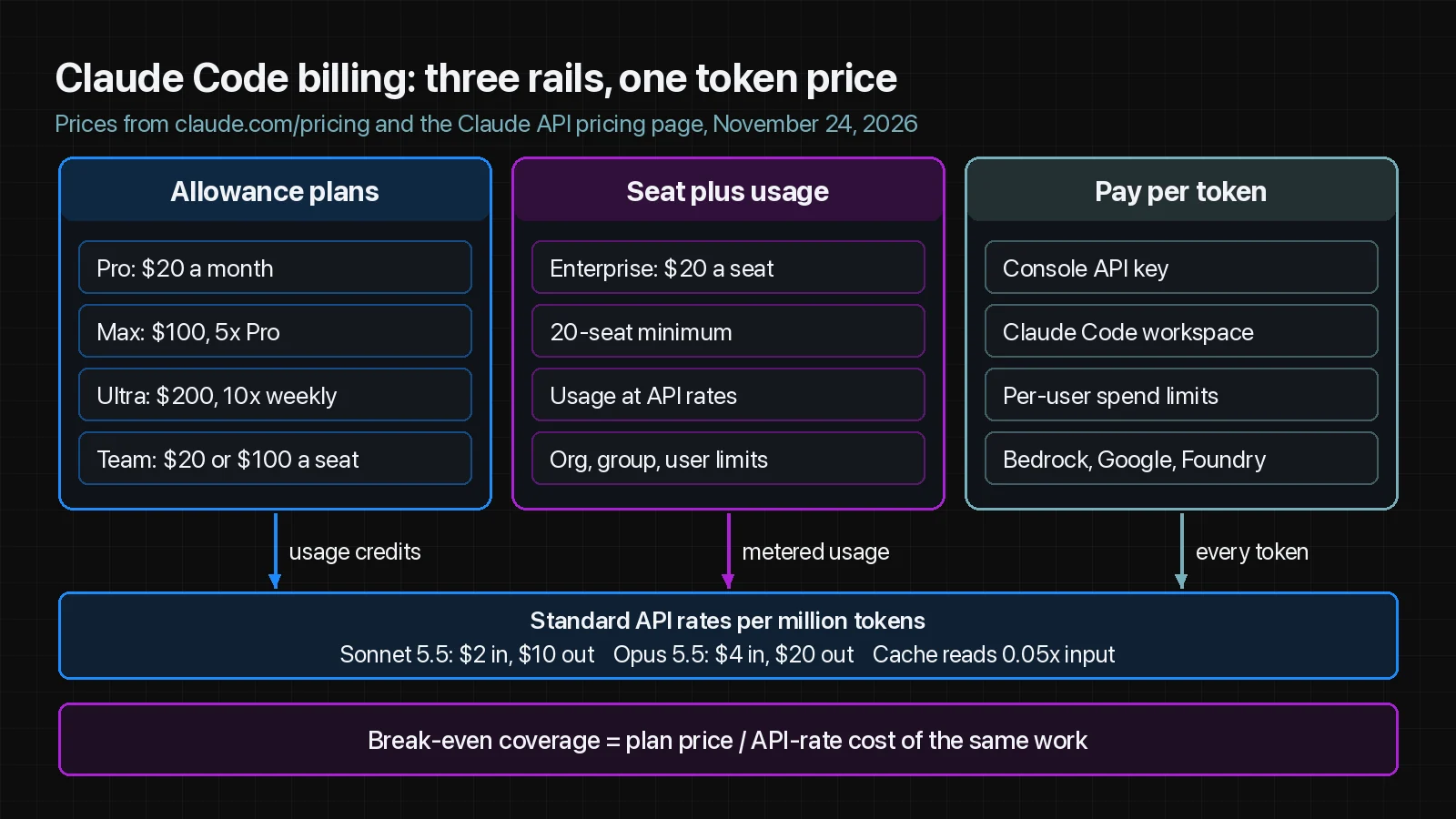
Claude Code is one product with several billing rails. The same CLI can draw on a Pro, Max or Ultra subscription, a Team or Enterprise seat, a Claude Console API key or a cloud provider account, and each rail meters, caps and reports usage differently. For an engineering leader, picking the rail is a procurement decision with real failure modes: allowances that are not published in tokens, bundled credits that cannot be spent where you expect, and organization spend caps that stop a rollout in its first week.
This guide covers that billing architecture: plan ceilings, per-token rates, the formulas that convert one into the other, and the FinOps controls that keep spend inside a budget. It deliberately leaves neighbouring decisions to the articles that own them. For which model each task should run on, read our Claude 5.5 model routing and prompt caching guide. For the startup overhead of MCP servers versus CLI tools, read the MCP vs CLI token-cost hierarchy. For seat prices across vendors, read Claude Code vs Codex vs Cursor. Every price below was checked against the linked Anthropic page on November 24, 2026; treat it as a dated input, because plans change.
How Does Claude Code Billing Work?
The Claude Code cost documentation starts from one sentence: Claude Code charges by API token consumption. What changes between plans is who pays for those tokens and where the ceiling sits. On Team and Enterprise plans, usage draws from each member's seat allowance; on the Console and on cloud providers, it is billed per token to your organization; and when an organization mixes sign-in methods, each developer is metered according to the method they authenticated with. In practice there are three rails:
- Allowance rail (Pro, Max, Ultra, Team and seat-based Enterprise): a flat price buys a usage allowance that resets on a five-hour session window and a weekly window, shared with Claude chat and Cowork. Usage inside the allowance is not metered in dollars.
- Usage rail (usage-based Enterprise, and usage credits on any paid plan): tokens are billed at standard API rates, either on top of a seat fee or after an allowance runs out.
- Token rail (Claude Console API keys, Amazon Bedrock, Google Cloud's Agent Platform and Microsoft Foundry): every token is billed per million at the platform's published rates to the organization or cloud account, and there is no allowance at all.
Does Claude Code cost money? Yes. The comparison grid on claude.com/pricing marks Claude Code as unavailable on the Free plan and included in every paid plan, where it shares the same usage limits as the rest of the plan. The only way to use it without a subscription is metered API billing, and new Console users receive free credits to test the API, according to the Claude API pricing page.
The credential, not the intent, decides the bill
Which rail a session uses is settled by authentication precedence. Per the Claude Code authentication docs, Claude Code takes cloud provider credentials first, then ANTHROPIC_AUTH_TOKEN, then ANTHROPIC_API_KEY, then an apiKeyHelper script, then CLAUDE_CODE_OAUTH_TOKEN, then Anthropic profiles, and only then the subscription login from /login. In interactive mode the developer approves an API key once; in non-interactive -p mode the key is always used when present. Anthropic's help center warns that an ANTHROPIC_API_KEY on the machine makes Claude Code use that key instead of the subscription, "resulting in API usage charges rather than using your subscription's included usage" (Claude Code with Pro, Max or Ultra).
Two governance consequences follow. A developer with a Max plan and a forgotten key in a shell profile moves to per-token billing without noticing, and /status is the quickest way to see which credential is active. Administrators who want one rail can deploy forceLoginMethod and forceLoginOrgUUID through device management; with either set, sessions that authenticate with ANTHROPIC_API_KEY, ANTHROPIC_AUTH_TOKEN or apiKeyHelper are blocked at startup. The docs add a caution worth copying into your runbook: the organization check applies to claude.ai logins, so do not rely on forceLoginOrgUUID to restrict saved Console credentials.
What Does Each Claude Code Plan Cost, and Where Is the Ceiling?
The break-even plan matrix below puts every route side by side. "c_day" is a developer's API-rate cost per active day and "C_api" is the same work priced for a month at API rates; both are defined in the formulas section.
| Route | Published price (USD) | How Claude Code usage is metered | Published ceiling | Beyond the ceiling | Break-even input |
|---|---|---|---|---|---|
| Pro | $20 a month, or $200 a year billed up front ($17 a month) | Plan allowance shared with Claude apps | Five-hour and weekly windows; at least 5x Free usage per five-hour session | Usage credits at standard API rates; Fable only through usage credits | D* = 20 / c_day |
| Max | $100 a month, monthly billing only | Plan allowance shared with Claude apps | 5x Pro every five hours and every week; separate weekly Fable limit, Fable up to half the weekly limit | Usage credits at API rates; the $100 monthly API credit cannot pay for Claude Code | D* = 100 / c_day |
| Ultra | $200 a month, monthly billing only | Plan allowance shared with Claude apps | 10x Pro weekly usage; no five-hour limit for verified accounts | Usage credits at API rates; the $200 monthly API credit cannot pay for Claude Code | D* = 200 / c_day |
| API direct (Console key) | No seat fee; per token at model rates | Every token billed to the organization | Tier spend cap: $500 Start, $1,000 Build, $200,000 Scale; your own lower limits | HTTP 429 until the next month or a higher tier | C_api = days x c_day |
| Team standard seat | $20 a seat a month billed annually, $25 monthly; 2 to 150 seats | Per-seat allowance shared with chat and Cowork | More usage than Pro; rolling five-hour and weekly windows | Usage credits with organization, group or member spend limits | f* = 20 / C_api |
| Team premium seat | $100 a seat a month billed annually, $125 monthly | Per-seat allowance shared with chat and Cowork | 5x the usage of a standard seat; Fable up to half the weekly limit | Usage credits with spend limits | f* = 100 / C_api |
| Enterprise (usage-based) | $20 a seat a month billed annually, 20-seat minimum, plus usage at API rates | Metered at API rates on top of the seat fee | No per-seat usage limit; admins set organization, group and user spend limits | The spend limit pauses the member or group | C = 20 x max(n, 20) + usage |
What the matrix cannot give you is the size of an allowance in tokens. Anthropic publishes multipliers, not quantities. The pricing FAQ says there is "no fixed message count" because usage depends on conversation length, model and features, and that Anthropic may limit usage in other ways, "such as weekly and monthly caps or model and feature usage", at its discretion (Claude pricing). The Max plan article repeats the same reservation. Any model that treats an allowance as a fixed token budget is therefore an assumption you must label.
Readers searching for a Max 20x tier will not find one on the pricing page checked today. It lists a single Max tier at 5x Pro usage; the $200 individual tier is Ultra, which provides 10x Pro weekly usage and removes the five-hour window for verified accounts. Because Ultra has twice Max's weekly usage for twice the price, the weekly price per unit of usage is identical. The structural difference is the missing five-hour window on verified accounts, which matters only for developers whose sessions run long enough to hit it.
Do not net bundled API credits against Claude Code cost. Max includes $100 and Ultra $200 a month in API credits "to build on the Claude Platform", and Team includes up to $500 a month in pooled API credits (Claude pricing). Anthropic's help center states that the monthly API credits included with Max, Ultra and Team cannot be used in Claude Code or the Claude apps, including for extra usage or usage credits (Pro, Max or Ultra; Team or Enterprise). They are a separate budget line for API projects, not a discount on the coding seat.
How the five-hour and weekly windows behave
According to How do usage and length limits work?, the five-hour period starts when you send your first message and resets in full five hours later. Weekly limits apply across all models, reset at a fixed day and time assigned to the account, and Max and Ultra add a separate weekly limit for Fable. Usage on claude.ai, Claude Code and Claude Desktop counts toward the same limit. For capacity planning that means a developer who spends the morning in long research chats starts an afternoon debugging session with less Claude Code headroom.
Claude Code's own messages tell an admin which ceiling a developer hit (costs). "You've hit your session limit" and "You've hit your weekly limit" are plan windows shared across all models, so switching with /model does not restore access; after a model-specific "You've hit your Opus limit", switching to a model outside that family does. Messages naming an individual spend limit, the org's monthly spend limit or a team's shared budget mean usage credits reached a cap an admin set. Fleet owners decide whether Claude Code waits for a reset and continues automatically through the autoContinueAtUsageLimit managed setting.
How Much Does Claude Code Cost per Token?
On a Claude Console API key, and on usage credits beyond a plan allowance, Claude Code is billed at the published Claude API rate of whichever model the session uses. The rates below come from the Claude API pricing page and match the API section of claude.com/pricing as fetched today. MTok means one million tokens. Amazon Bedrock and Google Cloud (Google managed) publish their own prices, and the same page notes a 10 percent premium for their regional and multi-region endpoints over global ones.
| Model | Base input | 5-minute cache write | 1-hour cache write | Cache read | Output |
|---|---|---|---|---|---|
| Fable 5.2 | $8 | $10 | $16 | $0.20 | $40 |
| Fable 5.1 | $10 | $12.50 | $20 | $0.25 | $50 |
| Opus 5.5 | $4 | $5 | $8 | $0.20 | $20 |
| Sonnet 5.5 | $2 | $2.50 | $4 | $0.10 | $10 |
| Haiku 5.5, prompts up to 100,000 tokens | $0.10 | $0.125 | $0.20 | $0.01 | $0.50 |
| Haiku 5.5, prompts over 100,000 tokens | $0.50 | $0.625 | $1 | $0.05 | $2.50 |
Per single token, Sonnet 5.5 costs $0.000002 for input and $0.00001 for output, and Opus 5.5 costs $0.000004 and $0.00002. Three modifiers move those numbers. Cache reads are priced at 0.05x base input on Opus 5.5 and Sonnet 5.5, 0.025x on Fable 5.2 and 5.1, and 0.1x on most other models, while a 5-minute cache write costs 1.25x base input and a 1-hour write 2x. US-only inference through inference_geo multiplies every token category by 1.1 on Claude 4.6 and later models. Fast mode on Opus 5.5 is $8 input and $40 output per MTok, and cache multipliers apply on top.
Haiku 5.5 is the one model priced by prompt length: a request whose prompt exceeds 100,000 tokens, counting cache reads and writes, pays the higher row for the whole request. Other Claude 4.6 and later models bill the full 1M-token context window at standard rates. Anthropic also notes that Claude 4.7 and later models use a tokenizer that produces roughly 30 percent more tokens for the same text, so token counts recorded on older models understate current cost. Finally, extended thinking tokens are billed as output, and Opus 5.5, Sonnet 5.5, Haiku 5.5 and the Fable models always think, so the effort level is the lever (costs).
Token-to-dollar formulas
Every response reports four token counts: uncached input, cache writes, cache reads and output. The formulas below turn them into dollars. They are arithmetic on Anthropic's published multipliers, not a vendor calculator, and the same structure extends from one request to one developer to one team.
# Per-request cost in USD. P_in and P_out are list rates in USD per million tokens.
cost = ( input_uncached * P_in
       + cache_write_5m * P_in * 1.25
       + cache_write_1h * P_in * 2.00
       + cache_read     * P_in * m_read   # 0.05 Opus 5.5, Sonnet 5.5; 0.025 Fable 5.2, 5.1; 0.1 most others
       + output         * P_out           # thinking tokens bill as output
       ) / 1_000_000 * geo                # geo = 1.1 with inference_geo "us", else 1.0

# One developer, one month, API key or cloud provider
C_api = active_days * cost_per_active_day

# Break-even active days for a fixed-price plan P
D_star = P / cost_per_active_day

# Subscription with usage credits on; f = share of API-rate cost the allowance absorbs
C_sub = P + (1 - f) * C_api               # cheaper than the API route when f > P / C_api

# A team of n developers (annual seat prices)
C_console    = sum(C_api)
C_enterprise = 20 * max(n, 20) + sum(C_api)
C_team       = 20 * n_standard + 100 * n_premium + (1 - f) * sum(C_api)
A sanity check against Anthropic's own example: the costs page shows a sample /usage session on claude-sonnet-4-6 with 1.2k input, 5.3k output, 940k cache-read and 50k cache-write tokens, reported as $0.55. At Sonnet 4.6 list rates ($3 input, $3.75 for a 5-minute write, $0.30 cache read and $15 output), the formula gives $0.0036 + $0.0795 + $0.282 + $0.1875 = $0.5526, which rounds to the same $0.55. Claude Code computes that figure locally at list price, and for subscribers it is not a billing number: their usage is included in the plan.
What prompt caching does to the bill
Cache reads and writes together are usually the largest share of a Claude Code bill because every request resends the conversation. The costs page explains that Claude Code re-reads session history at the cached token rate, so a one-line question late in a long session still pays for the whole context. On Opus 5.5 and Sonnet 5.5 a 5-minute cache write costs 25 times a cache read (1.25 divided by 0.05), and a 1-hour write costs 40 times. A cache miss on a 150,000-token Sonnet 5.5 context therefore costs about $0.375 to rewrite at the 5-minute rate against $0.015 to read; on Opus 5.5 the same miss costs $0.75 against $0.03.
The cache lifetime is itself a billing-rail decision. Per How Claude Code uses prompt caching, Claude Code requests the 1-hour TTL for the main conversation only on a subscription within plan usage. With usage credits, an API key or a cloud provider, the default is five minutes for every request. API-key teams whose developers step away for longer than five minutes can set promptCacheTtl to 1h (Claude Code v2.1.242 or later), trading a 2x write rate for fewer full-context rewrites; short bursts that never idle past five minutes pay the higher write rate for nothing, so this belongs in a measured pilot rather than a blanket policy. Switching models and turning on fast mode invalidate the cache, and so does connecting or removing an MCP server when tools load upfront rather than through tool search. Which model to switch to is the subject of our routing guide; the MCP side is covered in the MCP vs CLI decision record.
To see what the startup prefix alone costs a team at these list rates for each model, cache lifetime and hit rate, try the MCP vs CLI token cost calculator.
When Does a Max or Ultra Plan Beat Paying per Token?
The break-even question has two inputs: what a developer's work costs at API rates, and how much of that work the plan allowance absorbs. Anthropic publishes a reference point for the first. Across enterprise deployments, the costs page reports an average of around $13 per developer per active day and $150 to $250 per developer per month, with 90 percent of users below $30 per active day. Nobody publishes the second; you measure it.
The worked example uses an assumed token mix for one active day of interactive work, chosen so the Sonnet 5.5 total lands near that $13 average. It is an illustration, not a measurement. Replace it with your own /usage or OpenTelemetry data before you budget.
- Assumption: 30 million cache-read tokens, 1.5 million 5-minute cache-write tokens, 300,000 uncached input tokens and 500,000 output tokens, thinking included, per active day.
- Assumption: list prices on the Claude API with global routing, no fast mode, no negotiated discount and no tax.
- Prices used: the Opus 5.5 and Sonnet 5.5 rows of the per-token table above.
| Line item | Tokens (assumed) | Sonnet 5.5 | Opus 5.5 |
|---|---|---|---|
| Cache reads | 30,000,000 | $3.00 | $6.00 |
| 5-minute cache writes | 1,500,000 | $3.75 | $7.50 |
| Uncached input | 300,000 | $0.60 | $1.20 |
| Output, including thinking | 500,000 | $5.00 | $10.00 |
| Total per active day (c_day) | 32,300,000 | $12.35 | $24.70 |
The same day with no cache hits, every input token billed at base rate, would cost $68.60 on Sonnet 5.5 (31.8 million input tokens at $2 plus $5 of output). That gap is why cache behaviour matters more than headline input price. Moving every cache write to the 1-hour TTL raises the Sonnet 5.5 day to $14.60, and US-only inference raises the $12.35 day to $13.59.
Break-even formulas for one developer
For a fixed-price plan P and an API-rate day cost c_day, the break-even number of active days is D* = P / c_day. Above D*, the plan is cheaper only if the allowance actually covers the work. With usage credits on, overflow beyond the allowance bills at standard API rates, so a subscription costs C_sub = P + (1 - f) x C_api, where f is the share of the month's API-rate cost the allowance absorbs. The subscription wins when f is greater than P / C_api. That ratio, the break-even coverage, is the number a pilot should measure.
| Plan and price | Break-even days, Sonnet 5.5 day ($12.35) | Break-even days, Opus 5.5 day ($24.70) | Coverage needed, 18 days on Sonnet 5.5 | Coverage needed, 18 days on Opus 5.5 |
|---|---|---|---|---|
| Pro, $20 a month | 1.6 | 0.8 | 9% | 4.5% |
| Max, $100 a month | 8.1 | 4.0 | 45% | 22.5% |
| Ultra, $200 a month | 16.2 | 8.1 | 90% | 45% |
| Team standard seat, $20 billed annually | 1.6 | 0.8 | 9% | 4.5% |
| Team premium seat, $100 billed annually | 8.1 | 4.0 | 45% | 22.5% |
Read the table as a ceiling test. A developer who works 18 days a month on the Sonnet 5.5 profile would pay $222.30 at API rates. Max is the cheaper route if its allowance absorbs at least 45 percent of that work; Ultra needs 90 percent at this usage level, so it only pays off for developers whose API-rate cost runs well above $200 a month. The bound in the other direction is fixed: with usage credits on, a subscription can never cost more than the API route plus the plan price, because overflow bills at the same list rates.
Three published details bend the arithmetic. Fable is included on Max and Ultra only up to half the weekly limit and on Pro only through usage credits, so a Fable-heavy developer needs the Fable rates in the formula (Claude pricing). Fast mode on a subscription is paid from usage credits even while plan usage remains (fast mode). And once usage credits take over, Claude Code drops the main conversation from the 1-hour to the 5-minute cache TTL, so overflow sessions cache like API-key sessions.
How Should a Team Choose Between Team Seats, Enterprise and Console Billing?
At team scale, the admin setup guide frames the choice. Claude for Teams or Enterprise is the default recommendation, the Claude Console suits API-first organizations that want pay-as-you-go billing, and Amazon Bedrock, Google Cloud's Agent Platform or Microsoft Foundry suit organizations that want to inherit an existing cloud's compliance controls and billing. Each rail changes the cost formula:
- Team: $20 per standard seat or $100 per premium seat per month billed annually ($25 and $125 monthly), for 2 to 150 seats, mixed freely. Each member draws from a per-seat allowance on rolling five-hour and weekly windows, shared with chat and Cowork; premium seats get 5x standard usage. The allowance is the default ceiling, and members stop at it unless usage credits are on (costs).
- Enterprise: $20 per seat per month billed annually with a 20-seat minimum, plus usage at API rates. On usage-based Enterprise plans, including self-serve, there are no per-seat usage limits; consumption is billed at API rates (Team or Enterprise).
- Console: no seat fee, every token billed at API rates. Console sign-ins land in an automatically created Claude Code workspace that is rate-limited separately and, per the workspaces docs, is the only workspace that supports per-user monthly spend limits.
- Cloud providers: billed per token to your cloud account and capped with that cloud's budget controls. Cloud sessions, cloud scheduled tasks, Code Review, Remote Control and the Chrome extension need a claude.ai account, so plan whether developers also need seats.
The model below prices a 20-developer team on the Sonnet 5.5 day profile at 18 active days a month, which puts each developer at $222.30, inside Anthropic's published $150 to $250 monthly range. Seat prices are annual rates, and f is the share of API-rate cost the Team allowance absorbs. The same assumptions as the single-developer model apply.
| Billing route | Fixed monthly cost | Metered monthly cost | Total, or break-even coverage against Console |
|---|---|---|---|
| Console API keys | $0 | $4,446.00 | $4,446.00 |
| Enterprise, usage-based | $400 (20 seats at $20) | $4,446.00 | $4,846.00 |
| Team, 20 standard seats | $400 | (1 - f) x $4,446 | Cheaper than Console when f is above 9% |
| Team, 5 premium plus 15 standard seats | $800 | (1 - f) x $4,446 | Cheaper than Console when f is above 18% |
| Team, 20 premium seats | $2,000 | (1 - f) x $4,446 | Cheaper than Console when f is above 45% |
Two conclusions hold regardless of the token mix. Enterprise costs the Console bill plus a seat fee of $20 x max(n, 20) a month, $400 here, because both meter tokens at the same list rates. The fee buys the claude.ai surfaces and Enterprise controls such as SCIM, audit logs, role-based access and admin spend limits, not cheaper tokens; volume and committed-spend discounts exist for Enterprise and API customers through sales, and Anthropic does not publish the rates. Team seats, by contrast, are a bet on coverage: standard seats pay off once the allowance absorbs 9 percent of API-rate usage and premium seats at 45 percent. Because Anthropic does not publish allowance sizes, the only defensible way to set the seat mix is a pilot that records how often each developer hits the session and weekly windows.
One more line item sits outside every seat: Code Review, a Team and Enterprise feature, is billed on token usage through usage credits, separately from plan usage, and to the organization rather than the developer, even when other Claude Code traffic runs on Bedrock, Google Cloud or Foundry (Code Review costs). Its default trigger in a newly added repository is after every push, which multiplies cost by the number of pushes.
The Console tier cap is a rollout failure mode
API organizations carry a monthly spend cap set by usage tier: $500 on Start, $1,000 on Build and $200,000 on Scale, with no cap on Custom (rate limits). At 20 developers and $247 of organization spend per active day, a Start-tier organization reaches its cap in about two active days and a Build-tier organization in about four. API usage then pauses until 00:00 UTC on the first day of the next month, and requests return HTTP 429 with the error code enforced_spend_limit_reached and no retry-after header, so SDK retries keep failing until access resumes. Confirm the tier before inviting developers, and give CI its own workspace with a lower spend limit, because the organization cap is shared by every workspace.
The costs page also publishes per-user rate-limit recommendations that fall as teams grow, for example 50,000 to 75,000 tokens per minute per user for 20 to 50 users, because fewer people run Claude Code concurrently in larger organizations. Those limits apply at the organization level, so one developer can briefly use more than a calculated share while others are idle.
Which FinOps Controls Govern Claude Code Spend?
Spend governance depends on the rail. The costs page maps each setup to where you see spend, where you cap it and how you pull per-user numbers; the table adds the self-hosted gateway option from the gateway spend limits docs.
| Setup | See spend | Cap spend | Per-user reporting |
|---|---|---|---|
| Team or Enterprise seats | Spend report in org analytics, CSV export, updated daily; covers usage-credit spend, not usage inside the allowance | Seat allowance by default; usage-credit spend limits at organization, group or member level | Spend report CSV on Team; Enterprise Analytics API with a read:analytics key on Enterprise |
| Claude Console API | Console Cost page; Claude Code dashboard with spend and lines accepted per member | Organization and workspace monthly spend limits; per-user monthly limits in the Claude Code workspace | Claude Code Analytics API with an Admin API key, daily metrics about one hour behind |
| Amazon Bedrock, Google Cloud or Microsoft Foundry | Your cloud billing console | Your cloud budget controls | OpenTelemetry or an LLM gateway; Anthropic analytics do not see this usage |
| Claude apps gateway on a cloud provider | Gateway OTLP metrics with token counts | Daily, weekly or monthly caps per user, identity provider group or organization | Per-user attribution through the gateway |
OpenTelemetry export is the one reporting path that works on every rail, and the costs page calls it the only option that streams per-user token and cost metrics into your own observability stack in near real time. The Claude Code Analytics API covers only usage authenticated against a Console organization: when someone signs in with Pro, Max, Team or Enterprise, that usage belongs to the claude.ai organization and the API does not return it. A FinOps dashboard that joins these sources must record the billing rail beside every number, or it will add subscription estimates to invoice dollars.
Seven governance patterns that hold up
- Separate interactive and automated spend. Developers sign in through a seat or the Claude Code workspace; CI jobs use their own workspace-scoped key with a monthly spend limit and, where Anthropic bills you directly, email notifications. Workspace limits can keep a workspace below organization limits but cannot raise them (workspaces).
- Cap the Claude Code workspace's rate-limit share. For organizations with custom rate limits, Claude Code traffic counts toward the organization's overall API limits, and admins can set a lower limit for its workspace to protect production workloads.
- Watch the Default Workspace. A spend limit there might not stop Claude Code usage from members who sign in with a Console account and use the Default Workspace; the organization spend limit still applies to it.
- On seat plans, start with group limits. Anthropic's Enterprise consumption guide recommends group and per-user limits before an org-wide ceiling, because hitting the org limit stops everyone at once. Individual limits override group limits whichever is higher, and pooled group budgets email billing admins at 50, 75, 95 and 100 percent.
- Budget every headless run.
claude -p --max-budget-usdstops a print-mode run at a client-side estimate that includes subagent spend; spend can pass the cap, so leave headroom, and pair it with--max-turnsand a workflow timeout (CLI reference). - Report at contracted rates. The
modelPricingmanaged setting makes/usage, the status line,--max-budget-usdand OpenTelemetry use your contract's rates. It changes what Claude Code reports, not what Anthropic charges, and you must update it when the contract changes (settings reference). - Gate expensive surfaces and defaults. Enterprise admins can restrict models by role, cap effort per model and set the organization's default model, and Anthropic's recommended default in Claude Code is Opus. Roll Claude Code out by group rather than to every seat on day one. For identity boundaries across clients and teams, see our multi-tenant Claude Code architecture.
- Record the billing rail of every developer, and use /status to find stray ANTHROPIC_API_KEY credentials.
- Confirm the Console usage tier and its monthly spend cap before inviting more than a handful of developers.
- Set group or per-user spend limits before turning on usage credits.
- Give CI its own key, workspace, monthly spend limit and --max-budget-usd value.
- Deploy modelPricing if you pay contracted rates, so estimates match invoices.
- Export OpenTelemetry metrics from every machine, whatever the rail.
- Re-measure break-even coverage after any plan, price or default-model change.
Which Usage Patterns Break a Claude Code Budget?
Most overruns are session-shape problems, not price problems. The costs page lists the patterns that make a long session consume far more than its visible activity:
- Long context: every request resends the conversation, re-read at the cached rate, so stale context taxes every later turn. Running
/clearbetween unrelated tasks costs nothing. - Idle gaps longer than the cache lifetime: the first message back rewrites the full context at the cache-write rate.
- Background work: session-scoped scheduled tasks, cross-session messages and goal check-ins send the full context even while the developer is away.
- Parallelism: each subagent and workflow agent sends its own requests, and agent teams use approximately 7x more tokens than standard sessions when teammates run in plan mode.
- Compaction:
/compactreads the whole conversation it summarizes, so compacting a large context is itself a large request. - Fast mode: the first time it is enabled in a conversation, the entire context is charged at the full fast-mode uncached input price, $1.20 for a 150,000-token Opus 5.5 context at $8 per MTok.
- Model defaults: unexpectedly high spend on API and cloud plans usually traces back to long uncleared sessions or Opus left as the default model.
On paid plans, /usage attributes recent usage to skills, subagents, plugins and MCP servers and recommends a change for any behaviour behind 10 percent or more of recent usage. Its figures come from local session history on one machine, so they exclude other devices and claude.ai. For the instruction-file share of every request, see our CLAUDE.md vs AGENTS.md context budget guide; for orchestration choices that multiply requests, see subagents vs agent teams vs the Agent SDK.
What This Cost Model Does Not Settle
Anthropic does not publish allowance sizes in tokens for any plan, the criteria behind Ultra's verified accounts, or negotiated Enterprise and API discount rates, so none of them appear here as numbers. Amazon Bedrock and Google Cloud (Google managed) set their own prices, which this article does not model. The day profile is an assumption calibrated to one published average, not a benchmark, and no measurement was run for this article. Usage credits purchased on or after December 7, 2026 generally expire 12 months after purchase and are non-refundable, which matters if you prepay for overflow. Rerun the arithmetic whenever claude.com/pricing changes, and test the break-even coverage on your own team before you sign an annual commitment.
Primary sources checked November 24, 2026
- Claude plans and pricing
- Claude API pricing (model rates, caching, data residency, fast mode)
- Claude Code: Manage costs effectively
- Claude Code: Authentication and credential precedence
- Claude Code: Set up Claude Code for your organization
- Claude Code: How Claude Code uses prompt caching
- Claude Code: Fast mode
- Claude Code: CLI reference (--max-budget-usd)
- Claude Code: modelPricing setting
- Claude Code: Track team usage with analytics
- Claude Code: Claude apps gateway spend limits
- Claude Code: Code Review costs and usage
- Claude Platform: Workspaces and workspace limits
- Claude Platform: Rate limits and spend limits
- Claude Platform: Claude Code Analytics API
- Claude Help Center: How usage and length limits work
- Claude Help Center: What is the Max plan?
- Claude Help Center: Claude Code with Pro, Max or Ultra
- Claude Help Center: Claude Code with Team or Enterprise
- Claude Help Center: Usage credits for paid plans
- Claude Help Center: Claude Enterprise consumption guide
Frequently Asked Questions
How much does Claude Code cost per token?
At Claude API list rates, Sonnet 5.5 costs $2 per million input tokens, or $0.000002 each, and $10 per million output tokens. Opus 5.5 costs $4 and $20, and Haiku 5.5 $0.10 and $0.50 for prompts up to 100,000 tokens. Cache reads cost $0.10 on Sonnet 5.5 and $0.20 on Opus 5.5. Thinking bills as output.
Does Claude Code cost money, or is it free?
Claude Code is not part of the Free plan. It is included with Pro at $20 a month or $200 a year, Max at $100, Ultra at $200, and Team and Enterprise seats, or it bills per token through a Claude Console API key or a cloud provider. New Console users get free API credits for testing.
Is Claude Max worth it for Claude Code compared with the API?
It depends on coverage, not price alone. Max costs $100 a month, so it beats API billing only when a developer's API-rate usage exceeds $100 and the 5x Pro allowance absorbs enough of it. On our illustrative Sonnet 5.5 profile, Max breaks even after about eight active days. Measure limit hits in a pilot first.
How do Claude Code usage limits work on Pro, Max and Team?
Paid plans meter a five-hour session window that starts with your first message and a weekly window that resets at a fixed time. Claude chat, Claude Code and Claude Desktop share the same limits. Max gets 5x Pro usage, Ultra 10x Pro weekly without the five-hour window for verified accounts, and Team premium seats 5x standard.
Can Max or Team monthly API credits pay for Claude Code?
No. Anthropic's help center states that the monthly API credits included with Max ($100), Ultra ($200) and Team plans (up to $500 pooled) cannot be used in Claude Code or the Claude apps, including for usage credits. They are monthly credits for the Claude API, so leave them out of Claude Code budgets.
Why is Claude Code billing my API key instead of my subscription?
Claude Code ranks an ANTHROPIC_API_KEY environment variable above your subscription login, so once you approve the key, or in any -p run, usage bills to the Console organization at API rates. Run /status to see the active credential, unset the variable, and have administrators enforce the sign-in method with forceLoginMethod.