A team asks its agents for a launch video. One engineer pastes an install line into Claude Code, another into Codex, a third asks Grok to "use HyperFrames." A week later there are three outcomes: a skill that never loaded, a folder of HTML that renders locally, and a HeyGen invoice nobody planned for.
Nothing broke. The organization bought three different things with one name. This brief separates them, then gives engineering leaders what they need to decide: the deployment profiles, what a recent model benchmark does and does not prove, the cost model, the Remotion comparison, and a decision record.
Claims about HyperFrames below come from HeyGen's docs and repository, checked on October 5, 2026, and from our own run of the CLI (version 0.8.135) the same day. Field reports are labeled as field reports.
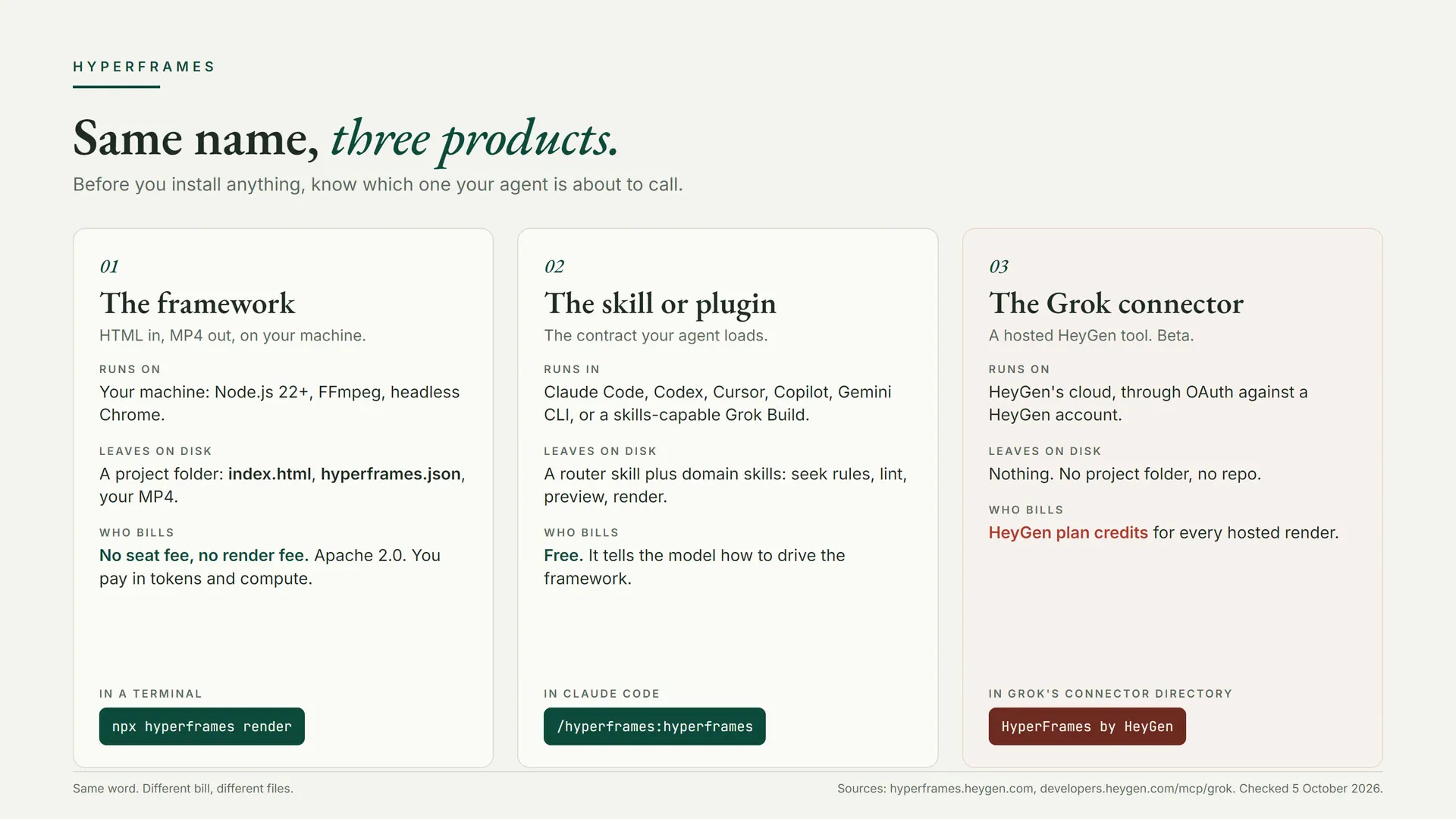
1. Three products, three bills
- The framework. HeyGen's open-source renderer: HTML, CSS, media, and a seekable animation timeline in, MP4 out. Apache 2.0. It runs on your hardware (Node.js 22 or newer, FFmpeg, headless Chrome). No seat fee and no per-render fee. The bill is compute plus the tokens your agent spends writing the composition.
- The skill or plugin. The contract an agent loads so that it writes compositions the renderer can actually seek: a router skill plus domain skills for composition structure, animation, the CLI, and media. Free. Installed per agent, per machine; HeyGen notes a plugin does not synchronize machines.
- The hosted Grok connector. "HyperFrames by HeyGen" in Grok's connector directory. It authenticates with OAuth against a HeyGen account, renders on HeyGen's infrastructure, and draws HeyGen plan credits. HeyGen calls the path beta, recommends a Creator plan or above, and says plans, limits, and billing can change independently. It leaves no project folder, so there is nothing to put through code review.
The architectural point: only the first two produce source you own. The third produces an asset from a vendor service. Both can be legitimate, but they belong under different policies.
2. Deployment profiles
For the local framework, the render target is a choice, not a fixed property. The CLI we ran lists the targets as commands. HeyGen's README documents HeyGen-hosted cloud rendering and AWS Lambda rendering; the 0.8.135 command list also includes a Google Cloud Run target. We ran local renders only.
- Developer workstation. Fastest feedback, preview open, agent in the loop. Not pinned unless you render in Docker.
- CI or a self-hosted render runner. The same CLI with a pinned version and a gate. Reviewable, repeatable, cheap for short pieces.
- HeyGen cloud (the cloud command). Offloads compute to HeyGen. Treat it like any vendor processor: data leaves your boundary and the bill is HeyGen's.
- AWS Lambda (the lambda command) or Google Cloud Run (the cloudrun command). Your cloud account, your data boundary, burst capacity. Young tooling: validate it before you put a deadline on it.
- Hosted Grok connector. A chat-driven path for people who will never open a repo. Fine for exploration; not a pipeline.
3. Why the output is governable
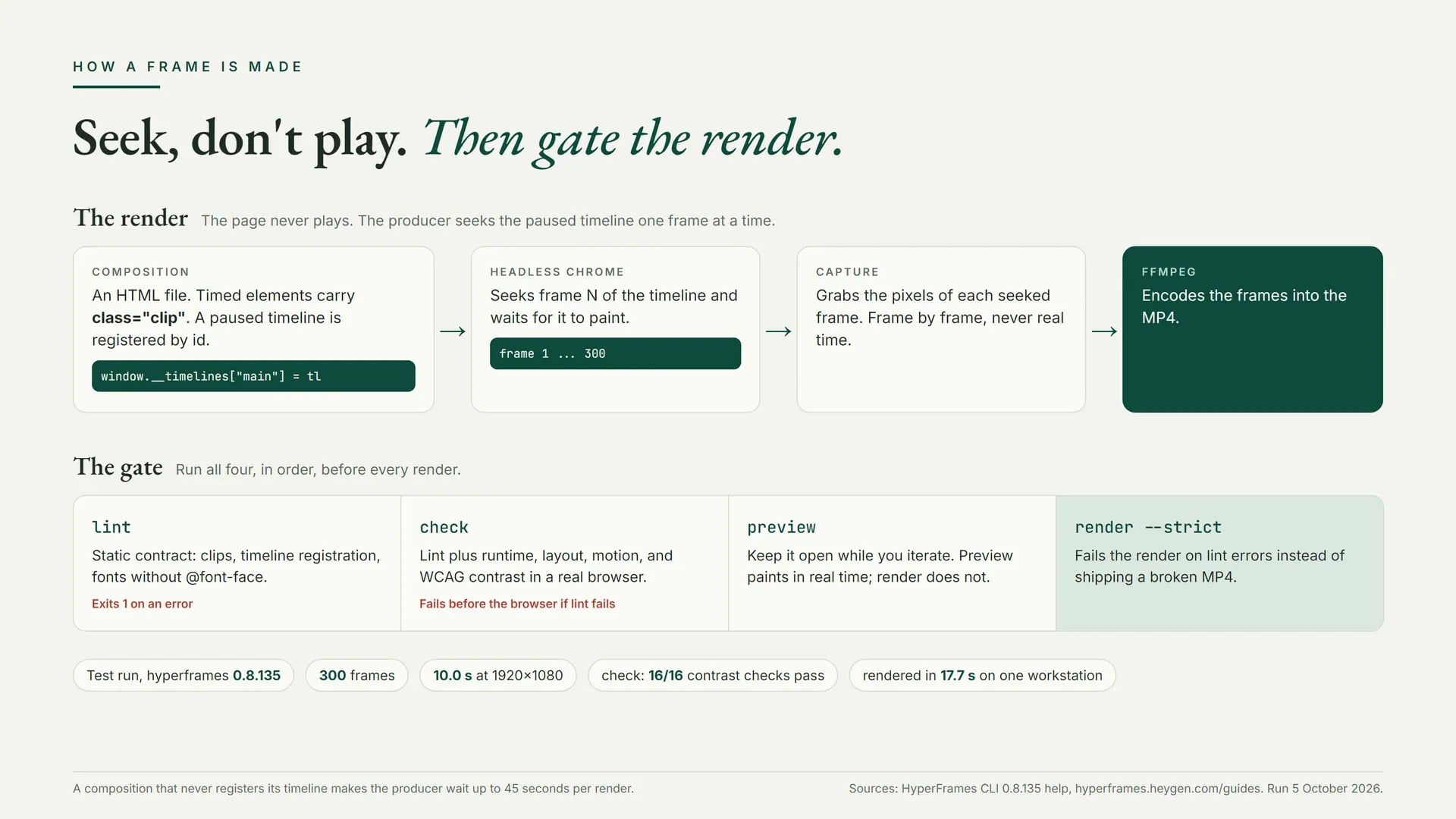
A HyperFrames composition is an HTML file with a contract. Timed elements carry a clip class and timing attributes. The page registers a paused timeline under the composition id. The renderer does not press play: headless Chrome seeks each frame, a capture step grabs the pixels, and FFmpeg encodes. Time is a parameter, not a clock.
That design is what makes agent-made video governable. The source is diffable. The CLI has a static lint and a browser-based check that covers runtime errors, layout collisions, motion, and WCAG AA contrast, and HeyGen's guide says both must pass before a render. On our 10-second test card, lint failed first on a font the renderer could not supply, and check refused to report a pass until lint was clean. After one fix: 0 layout issues across 9 samples, 16 of 16 contrast checks passing, 300 frames rendered in 17.7 seconds.
One caveat for anyone who wants byte-level reproducibility: our hardware-GPU and software renders of the same source were visually identical (SSIM 0.9986) but had different hashes. Determinism at the byte level needs a pinned environment, which is what the CLI's Docker mode is for.
4. The Opus 5.5 benchmark, and the dissent
On September 28, 2026, Bin Liu posted results from a benchmark attributed to HeyGen, DeepMind, and Kaggle (the Code2Video work). Per the post, Claude Opus 5.5 reproduced the HyperFrames contract (the composition id attribute and the timeline registry) in 20 of 20 bare runs, and passed the real HyperFrames linter 20 of 20 times when given only the framework's name. The same post said eleven other models, including Grok 4.6, did not.
Read it for what it is: a vendor-adjacent benchmark reported in a social post, not an independent audit. The post's headline framed the result as training on HyperFrames; the body showed recall of the contract without tools. Those are different claims, and only the second was shown.
The dissent is worth holding at the same time. An X post on September 26, 2026 argued that a thin wrapper is irrelevant now, because Opus 5.5 can invent motion on its own, and that HyperFrames mattered more in the Opus 4.6 era.
Our position: recall of the contract is not the loop. The skill is also the router, the lint and check discipline, the preview habit, and the render flags. A model that remembers the attributes can still hand you a pretty page that was never checked, or an MP4 nobody gated. Install the skill regardless of model. It costs nothing, and it makes the cheapest model on your roster behave more like the best one on this task.
5. Grok Build still wants the skill installed
The same benchmark note did not show Grok 4.6 recalling the contract. That is not evidence Grok cannot make the video. It is a reason not to ask Grok to remember the contract. Install the skills route and invoke the router explicitly.
HeyGen's plugin guide does not name Grok Build. A Grok Build skills note from October 1, 2026 says it discovers skills in its own folders and in Claude-compatible locations. We confirmed the shape locally: on Grok Build 1.0.46, its inspect command listed discovered skills, including ones from Claude-compatible paths. So a normal skills install is visible to Grok Build. No invented marketplace is required, and none should be used.
6. Effort and token economics
On the local path, the variable cost is tokens, not renders. A title card is cheap. A multi-scene launch with a storyboard, voiceover, and revisions is not; a skill author on r/ClaudeCode warned in June 2026 that one HyperFrames launch video does a lot of planning. We are not publishing a dollar figure, because the honest number depends on model, effort, and how many revision turns your team tolerates.
- Spend effort where decisions are made: high effort on the storyboard pass, medium on scene tweaks. A separate Opus 5.5 coding note found medium or high to be the value settings, with the highest settings costing much more for small gains.
- Buy down revision turns with inputs. A real URL, a PR, a CSV, or reference frames beat a cold prompt. In one Reddit thread a commenter said a model invented a product UI that did not match the real app; pointing the workflow at the real product fixed it.
- Freeze what works. Field practice from late September 2026: write the settled answers to BRIEF.md (HeyGen's documented resume file) and keep liked frames in a motion notes file the agent reads before the next build. That is how you stop every clip from looking the same.
- Treat one-shots as first cuts. A Claude Code user reported Opus 5.5 one-shot a tutorial video in under 30 minutes, rough edges left in. Budget for the review pass.
7. HyperFrames or Remotion
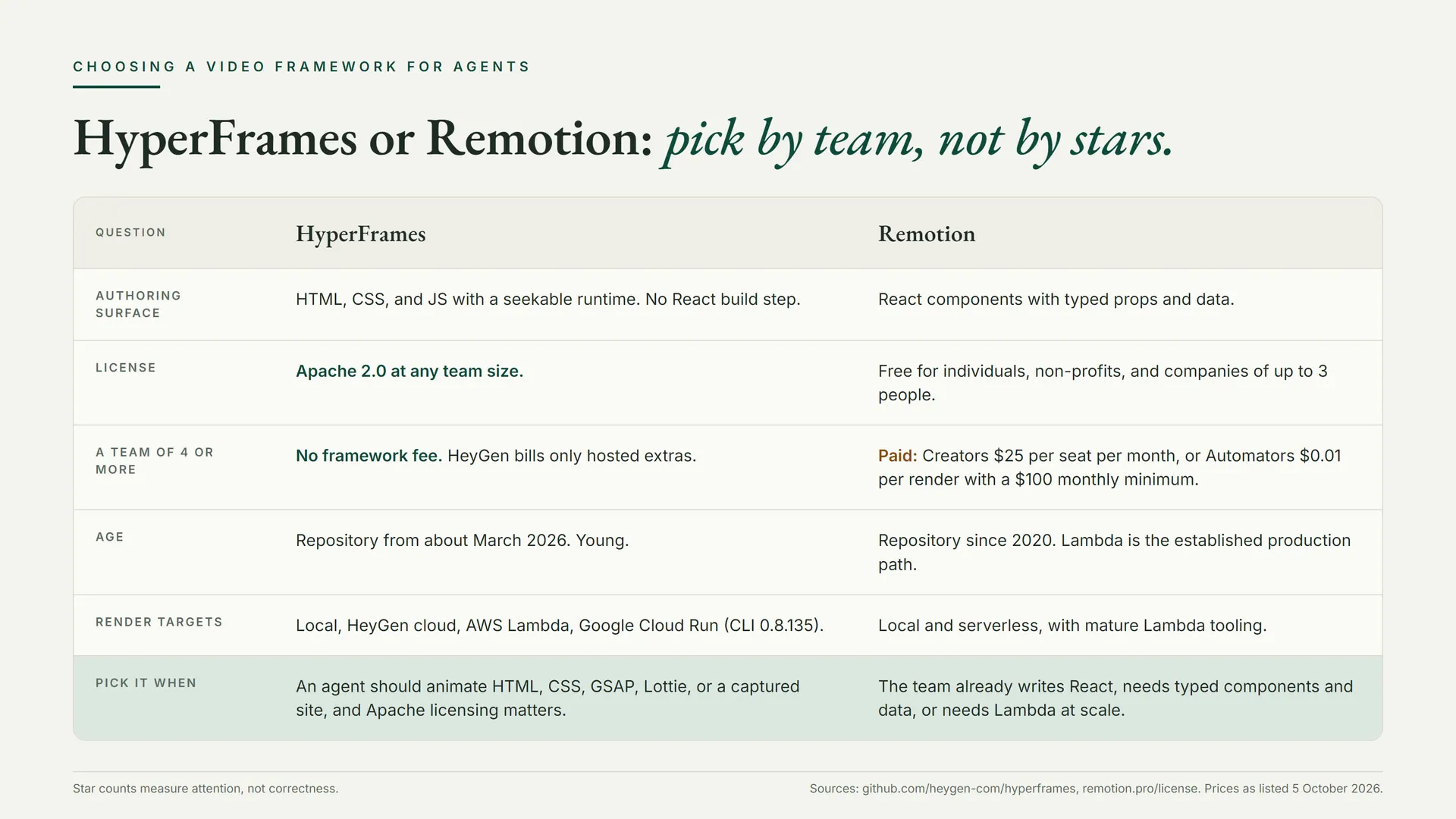
- Authoring surface. HyperFrames: HTML, CSS, and JavaScript with a seekable runtime, no React build step. Remotion: React components with typed props and data.
- License. HyperFrames: Apache 2.0 at any team size. Remotion: free for individuals, non-profits, and companies of up to three people.
- A company of four or more. HyperFrames: no framework fee; HeyGen bills only hosted extras. Remotion: Creators at $25 per seat per month, or Automators at $0.01 per render with a $100 monthly minimum; Enterprise starts at $500 per month.
- Maturity. Remotion's repository dates to 2020 and its Lambda path is the established production renderer. HyperFrames is young, from about early 2026. Neither fact is a quality verdict, but age is a real risk input.
- Pick HyperFrames when an agent should animate HTML, CSS, GSAP, Lottie, or a captured site, and Apache licensing matters. Pick Remotion when the team already writes React, needs typed, data-driven components, or needs a proven Lambda pipeline at scale.
- Popularity. Both have tens of thousands of GitHub stars. Star counts measure attention, not correctness.

8. Architectural Decision Record
Adapt this to your organization. It assumes agents already write code in your repositories and that video is an occasional, not core, product.
ADR-0xx: Agent-authored video uses local HyperFrames behind a gate

Status: Proposed
Date: 2026-10-05

Context
  Teams are producing launch, tutorial, and PR videos with coding agents.
  "HyperFrames" currently means three things in our org: the open-source
  framework, the agent skill or plugin, and HeyGen's hosted Grok connector.
  Each has a different bill, data boundary, and audit trail.

Decision
  1. Default path: the local framework, source committed to the owning repo,
     CLI version pinned in package.json scripts.
  2. Agents: one install route per agent per machine (plugin where a named
     plugin exists, standalone skills otherwise). Inventory checked at
     onboarding. No fork or personal marketplaces.
  3. Gate: lint and check pass before any render; CI renders with --strict
     and --no-best-effort; a human or separate reviewer agent watches the MP4.
  4. Hosted renders (HeyGen cloud, the Grok connector): allowed for
     exploration only, under a named budget owner, with no customer data.
  5. Remote targets (Lambda, Cloud Run): pilot before any deadline depends
     on them.

Consequences
  + Video is reviewable like code; no per-seat framework cost at any size.
  + Model choice stays open: the skill carries the contract.
  - Token spend on multi-scene pieces is real and must be watched.
  - Young tooling: pin versions and re-run the gate on upgrades.

Revisit when
  - HeyGen publishes an official plugin for an agent we use on the skills route.
  - A remote render target is needed for volume.
  - Remotion's license terms change (its license notes changes in v5.0).
9. Governance checklist
- Name the product in every request: framework, skill, or connector.
- One install route per agent per machine; verify the inventory at onboarding.
- Pin the CLI version; upgrade in its own change with the gate re-run.
- Lint and check before every render; strict render flags in CI.
- Local media and named fonts only; no expiring URLs in a composition.
- Hosted renders have a budget owner and a data rule.
- Every skill gets the same pre-install read, regardless of its star count.
Cross-site references
- Learn Claude Skills: Install HyperFrames Without Mixing Routes: hands-on install, first prompt, and the gate for skill authors
- ClaudeSkillsGitHub: HyperFrames in a Repository: pinning, CI workflow, and PR review for maintainers
- Learn Claude Skills: Read Before You Run, the 5-minute skill audit: the pre-install read every skill should get